


Clean Fuel: Every Ingredient, and Why It Is In There
CLEAN FUEL
A professional ballerina takes class in the morning, rehearses through the afternoon, and performs at night. Six days a week. Whatever she drinks before class has to do two jobs at once: wake her up, and not wreck her.
That is a harder brief than it sounds. Most of what gets sold as athletic fuel is a delivery system for refined sugar and food dye. Most of what gets sold as flavored coffee is a delivery system for syrup that arrived on a pallet. Athletes read labels for a living, and the labels are usually bad.
So here is ours. Every ingredient on the Gaffle menu, and the actual reason it is in there.

Caffeine is the most studied performance aid there is
Not the trendiest. The most studied. Caffeine has dominated sports supplement research for decades, and the conclusions are unusually consistent for nutrition science.
The International Society of Sports Nutrition puts the effective range at 3 to 6 milligrams per kilogram of body mass. In that band, caffeine reliably improves aerobic endurance, and gives smaller but real benefits to muscular endurance, movement velocity, strength, sprinting, and jumping. It also sharpens attention and vigilance, which matters as much in a four-hour rehearsal as it does in a race.
Two things worth knowing, because nobody selling coffee will tell you either.
More is not better. Doses around 9 mg/kg bring side effects without bringing extra performance. The ceiling is real.
And if you want a precise dose, capsules beat coffee. The literature is clear that anhydrous caffeine is the more reliable vehicle, simply because you know the number. Coffee varies by bean, roast, grind, and method. We are not going to pretend a latte is a lab instrument. What a latte is, is the thing you will actually drink every day for years. Adherence beats precision for everything except race morning.
Cold drip, because acid is the thing that stops you
Heat is what makes coffee harsh. Hot water pulls bitter and acidic compounds out of the bean along with everything else, and you taste it as sharpness and feel it an hour later.
Cold drip never touches heat. Cold filtered water passes through the grounds one drop at a time, pulled by gravity, for hours. The water is always moving and always fresh, so it takes the sugars and oils and leaves most of the acid behind.
For an athlete this is not a flavor note. It is whether you can drink coffee at 8am and still take class at 9:30 without your stomach arguing. Lower acid means it sits easy on an empty stomach, which is when most training happens.
The concentrate itself has two ingredients. Organic specialty beans and filtered water. That is the whole list. It sounds like a low bar until you read the cold coffee case at the grocery store: gums, stabilizers, natural flavors, preservatives, sugar.

Maple syrup instead of sugar
This is the single biggest decision on our menu, and the one that costs us the most.
Maple syrup sits at roughly 54 on the glycemic index. Table sugar sits around 65. It carries manganese, zinc, and more than sixty identified polyphenols, and the minerals and organic acids in it appear to slow sugar absorption a little compared to the same amount of plain sucrose.
Here is the honest part. Maple syrup is still about 67 percent sucrose by weight. It is still sugar. Anyone who tells you otherwise is selling you something. What it is not is refined sugar, and it is not a syrup built in a flavor lab with preservatives to keep it shelf stable for two years.
The difference you feel is not a nutritional miracle. It is the absence of the crash.
Cardamom and cinnamon
Two of the oldest spices in the trade, and both of them do more than flavor.
Cinnamon has genuinely interesting research behind it around blood glucose response. Call that promising rather than settled, because the studies vary in dose and quality and the effects are modest. But a spice that leans in that direction, in a drink that already contains sweetener, is a better choice than one that does nothing.
Cardamom has been used as a digestive aid for centuries and carries a real antioxidant load. It is also one of the most expensive spices we buy by weight, which is exactly why most places use a flavoring instead.
Both of them do something a syrup cannot: they make a drink taste sweeter than it is. Warm spice reads as sweetness on the palate, which means we can pour less maple and still land the drink. That is the trick, and it is not a trick at all.
Rose
Rose is the ingredient people assume is decorative. It is the one we are most careful about.
Rose carries polyphenols and has a long history in Persian and Indian kitchens as a cooling ingredient, which is the right instinct for a cold coffee menu in Southern California. But the reason it is on our menu is simpler: rose done properly is one of the most distinctive flavors in coffee, and rose done badly tastes like soap.
Getting it right means real rose rather than rose flavoring. There is no shortcut and no substitute, and you can taste which one a shop chose in about a second.
Pistachio
Pistachio is the ingredient with the strongest athletic case on the whole menu.
Pistachios are one of the very few plant foods that provide adequate levels of all nine essential amino acids, scoring around 81 percent of casein on the standard protein quality measure. That puts them in a category with soy and quinoa and almost nothing else in the nut aisle. They are also lower in fat and carbohydrate than most nuts, and they bring potassium, phosphorus, magnesium, fiber, and arginine.
For someone training hard, a pistachio drink is closer to a recovery drink than a dessert. It is the one on our menu that genuinely pulls double duty.
Mint
Mint earns its place through menthol, which is why it has been a digestive remedy for as long as anyone has written recipes down.
Practically, mint is what makes a cold drink read as colder than it is. That is thermoreception, not temperature, and it is the reason a mint drink works in August in Temecula when nothing else will.
Organic, because you cannot audit a rinse
Our beans are organic. So are the ingredients we can source that way.
The argument for organic in coffee is not mainly about the residue on your bean, though that matters. It is that coffee is grown in places where pesticide regulation is thin and enforcement is thinner, by people who are standing in the field. Buying organic is the most direct lever a small roaster has.
What is not in any of it
This matters as much as the ingredient list.
No refined sugar. No artificial dyes. When a drink is bright and the color has no food source, the color came from a lab. No artificial sweeteners. No flavor syrups off a distributor shelf. Every syrup we pour is made in the shop, which is the only way to actually know what is in it.
The cost of this is real. House syrups spoil. Real spices cost multiples of their flavoring equivalents. Maple costs many times what sugar costs. We have made the menu smaller than it could be because of it.
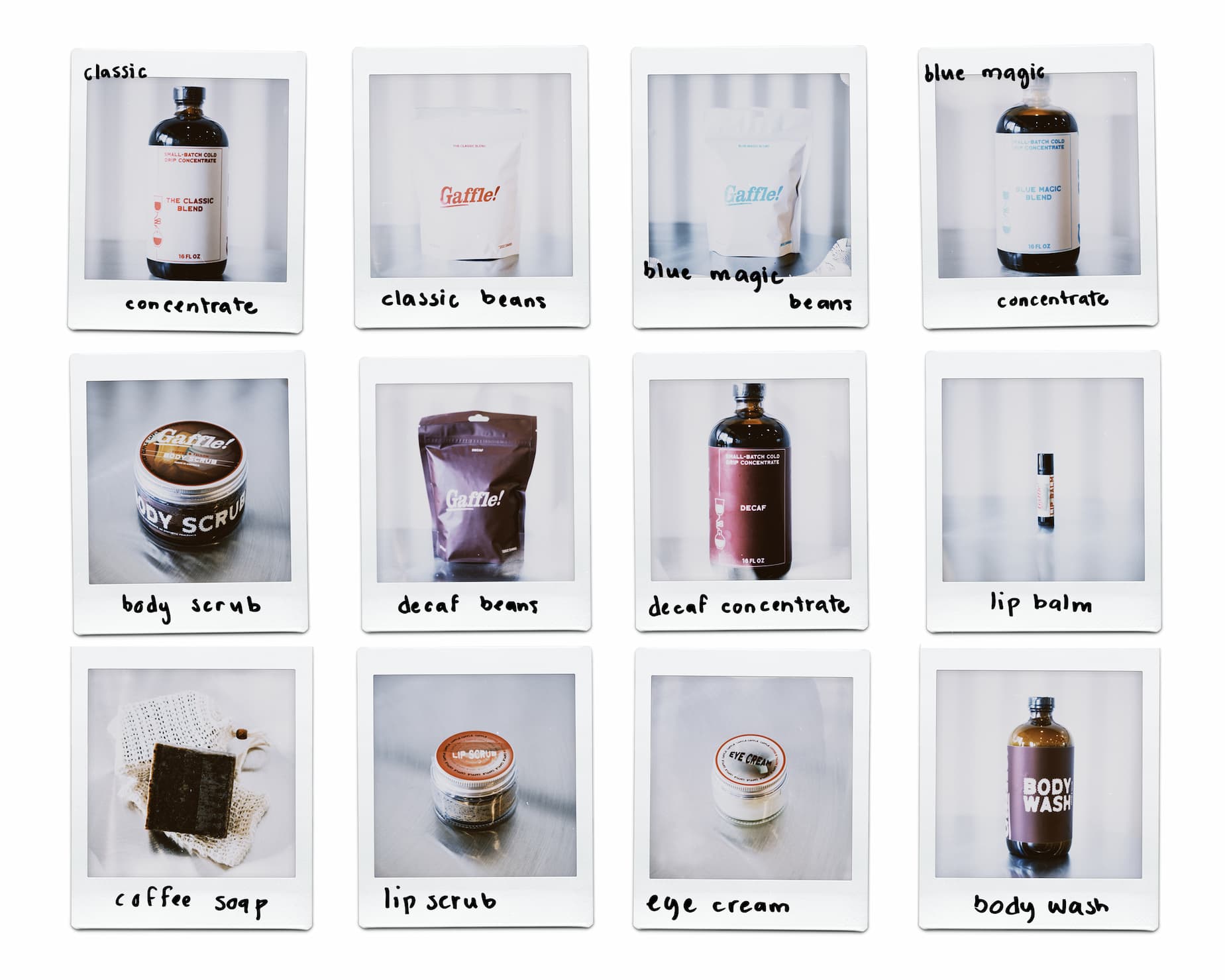
The recovery side
Coffee does not stop being useful once you have drunk it. Our skincare is built from the same beans, and caffeine applied to skin is a vasoconstrictor, which is why it turns up in eye creams for puffiness.
The rest of the formulas are grass-fed tallow, cold-pressed olive oil, jojoba, raw honey, and beeswax. For anyone showering two or three times a day between sessions, a body wash and scrub that support the skin barrier instead of stripping it is not a luxury.
How to actually use it
The standard timing in the literature is about 60 minutes before you train. That is when blood caffeine peaks for most people.
Concentrate is the flexible format. Cut it 1:1 with water or milk for a full-strength cup, or stretch it to 1:4 when you want the ritual without the load. Take it straight if you know what you are doing.
And know your own response. Caffeine sensitivity is partly genetic, and habitual intake changes the picture. Some people do fine with an afternoon cup. Some people need to stop at noon or lose a night of the sleep that recovery actually depends on. Nothing in a bottle beats sleep.
Clean fuel is not a claim on a label. It is a short ingredient list that survives being read out loud.
Find it at the shop at 27725 Jefferson Ave, Temecula, or start with the cold coffee concept.
ABOUT GAFFLE
Gaffle is the world's first dedicated cold coffee concept, built in Temecula, California. Coffee is where it starts. The world around it, from skincare to clothing to the Gaffle Girls, is where it goes. If you are not shaking, you need another cup!